The Legibility Trap
Ninety-four percent. This is the percentage of businesses that implemented AI in some of their activities but failed to reap any benefit from this, according to a 2025 McKinsey survey. It is a staggering statistic. Millions of dollars invested in AI setups, years of hype, and the majority of organizations are effectively conducting expensive experiments of an unknown ROI. The critical question is not whether AI fails in those organizations but what exactly they are trying to optimize for.
Performance Management is the area where the former question is especially relevant. AI changes the ways in which companies assess workers' performance, set targets, and determine who excels and who underperforms. Technologies used are sophisticated, the marketing message is convincing, and the gap between companies' goals and what they reward will continue widening for years to come.
The Dashboard Illusion
As a rule, the goal of implementing AI into performance management is stated as increased fairness and development. The vendors promise the personalized feedback, bias-free calibration, and continuous cycle of improvements to help workers develop themselves. The message is powerful, and certain aspects of it are true indeed. AI can solve the recency bias in the yearly performance reviews, aggregate feedback from multiple sources, and spot employee engagement issues before they lead to loss of the worker.
However, the technology measures whatever it can. The closer inspection of the goals shows a narrower purpose – clarity. The companies reward the things that can be measured continuously and automatically: OKR achievement rate, speed of task execution, the amount of completed work, and risk of leaving. All these are backward-looking and output-oriented by definition. You cannot apply a predictive model to mentoring or difficult conversations with clients.
The bad incentive trap is well-known. Where the performance criteria are not verifiable, people are incentivized to achieve visibility rather than actual results. A worker will soon discover that what raises her score is not outstanding performance but things that the system sees. Emails sent. Tasks done. OKRs accomplished. The smart worker who can phrase her work in terms of OKRs will prevail over the quietly effective one who works on tasks that are hard to quantify.
On top of it, there is a problem of leadership alignment. A 2026 Grant Thornton survey showed that CIOs and CTOs are five times more likely to believe that the workforce of a company is ready to implement AI than COOs. It is not a matter of technical knowledge. It is simply two conflicting views of the same company, where people who know how things really work are less sure than people funding the implementation. The result is AI-based performance management tools in companies that do not agree what performance means.
Who Will Be Promoted?
One of the interesting findings of AI productivity researches is that in some cases, the role of AI in closing the skill gap is greater than that of accelerating the performance. In controlled conditions, AI increases performance regardless of the skill level of the worker but reduces the gaps between the performance of low-skilled and high-skilled workers the most. In other words, the difference between the poor analyst and the skilled one would decrease the most. The evidence for this is provided by the 2025 Stanford AI Index, which shows that AI helps close the skill gaps in most cases.
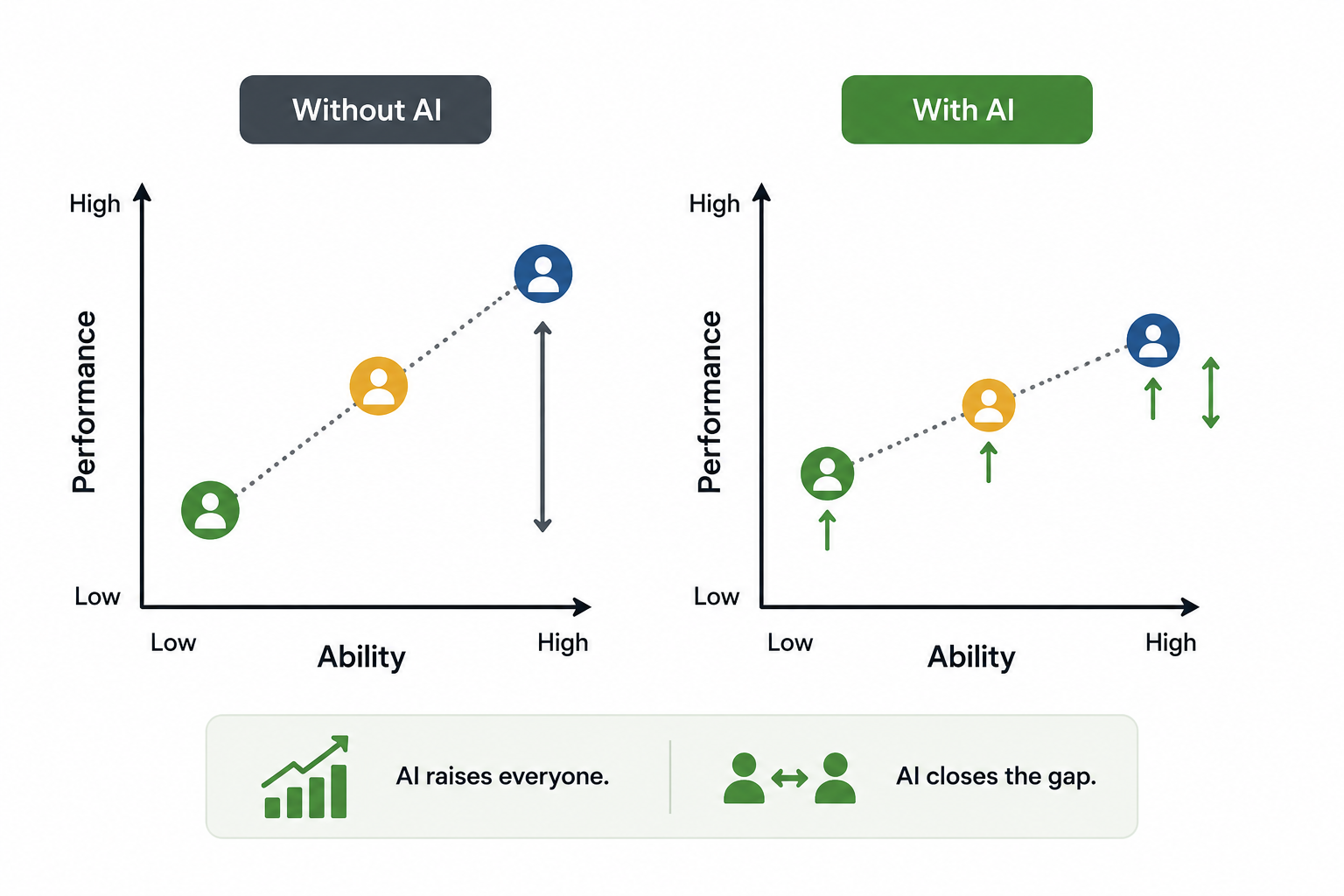
At first glance, it is a good news for individuals. However, it is a dangerous development for the organization as a whole. According to the 2025 AI Productivity Paradox Report, developers working in teams using high amounts of AI technology accomplished 21% more tasks and merged 98% more pull requests. However, the time of code review increased by 91%, since the human approval became the bottleneck. An individual output increased, but the total throughput stopped.
Even worse, the risk of productivity decreases rather than disappears. The higher standards imposed on the worker because of AI implementation create additional pressure on those who struggle with the technology. A 2025 study conducted by Brynjolfsson, Chandar, and Chen found out that the early-career workers in the jobs involving a lot of AI experienced 15–16% employment decline, which happened mostly in the cases of more automation than augmentation by the AI. The floor gets higher, and some workers cannot reach it, and leaders raising it often do not even bother to find out who they are.
Costs That Do Not Show Up in the Dashboard
There is another risk, which many companies neglect. Those factors that are responsible for longevity of the organization as an entity (such as mentoring, knowledge transfer, risky experiments, and accumulation of institutional memory) do not show up as outputs in a quarter. The performance systems optimized for the measurable things cut out the rest automatically, not intentionally.
According to the 2025 study conducted in Frontiers in Psychology, AI usage leads to increased knowledge hiding. People working in AI-monitored settings become less willing to share their expertise due to the work anxiety and feeling less connected to the organization. Instead of spending 30 minutes on mentoring a junior colleague, a worker becomes evaluated on her task throughput, and the mentoring becomes a liability against her metrics. No one told her to stop. The system does it every day.
It is the slow erosion of the institutional capital almost imperceptible until it becomes critical. If the organization loses its informal networks of knowledge, it will notice that only when something crucial for it fails or many experienced people retire, taking the context with them. Then, the dashboard will show that the performance was great.
The problem grows even more severe. Gartner estimates that 20% of organizations will use AI to eliminate the management layers and cut the number of middle managers more than by half in 2026. Middle managers are the carriers of culture. They recognize the signs of burnout long before the worker appears on the attrition scorecard. They do the informal coaching which is not recorded anywhere. Flattening this layer makes the organization more efficient, but it eliminates the glue holding it together.
A New Pattern of Wages
The wage data provides a clear picture. According to the 2025 PwC Global AI Jobs Barometer, the wage premium of AI-skilled workers reached 56%, doubling the 25% of the previous year. The 2024 Lightcast study analyzed 1.3 billion job listings and found that positions requiring AI skills had average wages higher by approximately $18,000 per year. Over half of such roles were not within the scope of the tech sector.
However, this big number hides the division. The 56% premium goes primarily to those workers who can operate the AI systems, not to those whose jobs are augmented by them. Workers with augmented jobs and those not upskilled receive the wage stagnation, not the premium. The mid-skill white-collar worker whose job is still relevant but has decreased leverage does not get the PwC number.
The standards of what is good enough are changing, and this change affects primarily the AI-visible tasks. The traditional metrics of performance such as activity (emails, phone calls, reports) become irrelevant in the era of AI when the latter can generate the full report in minutes. The relation of efforts and results changes. The standards are not increasing for everybody. They are increasing for the things that can be seen by the system, and workers who fail to demonstrate the AI-augmented results are effectively failing at the new unspoken standards. No memo is needed to introduce them. The benchmark just moves.
Will Human Judgment be Valued or Just Celebrated?
The optimistic perspective is quite obvious. With the increase in the share of the measurable, repetitive thinking, the human judgment is becoming more valuable. Microsoft Research's 2026 Future of Work report states that the importance of the human judgment – spotting opportunities, managing the ambiguity, making the right choices among the AI-generated options – grows as the AI capabilities improve. SHRM's 2026 State of AI in HR report indicates that the HR professionals are unanimous in their belief that human intelligence is irreplaceable in areas requiring empathy, nuanced judgments, and human connection.
However, the problem is not that this statement is wrong. It is that the organizations are not measuring and rewarding the human judgment yet. The companies that state that they are valuing judgment evaluate their workers based on the metrics of OKR accomplishment. The leaders calling creativity a critical skill are evaluating people by the speed of tasks. Intentions and incentives are going into opposite directions, and the incentives win.
The regulations are coming that might help resolve the problem. The EU AI Act introduced the need of transparency, human oversight, and employee notification for the workplace AI usage such as performance evaluation in 2025. The ban of emotion recognition in the workplace entered into force in February 2025. Whether the US will regulate AI management in the workplace similarly remains uncertain, but the global trend is to govern algorithmic management increasingly.
The honest prediction is that human judgment will be widely celebrated for several more years but poorly measured. The companies will write job descriptions that require ambiguity tolerance and strategic thinking and evaluate workers based on tools that cannot detect them. The ability to bridge this gap will be highly valued, but it is quite a different skill than the one that the organizations state they want.
Sources: McKinsey, "The State of AI in 2025: Agents, Innovation, and Transformation" (November 2025); PeopleGoal, "AI in Performance Management" (2026); Reworked.co, "Why AI Productivity Metrics Are a Slippery Target" (February 2026); Grant Thornton, "2026 AI Impact Survey Report"; Stanford HAI, "2025 AI Index Report"; International Center for Law & Economics, "AI, Productivity, and Labor Markets" (February 2026), citing Caplin et al. (2024); Faros.ai, "AI Productivity Paradox Report 2025"; Brynjolfsson, Chandar & Chen (2025), "Canaries in the Coal Mine" via ADP microdata; Liu et al., "When Robot Knocks, Knowledge Locks" — Frontiers in Psychology (July 2025); Cornell University / Chronicle research (2024); PwC, "2025 Global AI Jobs Barometer" (June 2025); Lightcast analysis of 1.3 billion job postings (2024), via Fortune; Finflowmax / PwC synthesis (2026); Microsoft Research, "New Future of Work" (April 2026); SHRM, "State of AI in HR 2026 Full Report" (April 2026); EU AI Act (in force 2025)